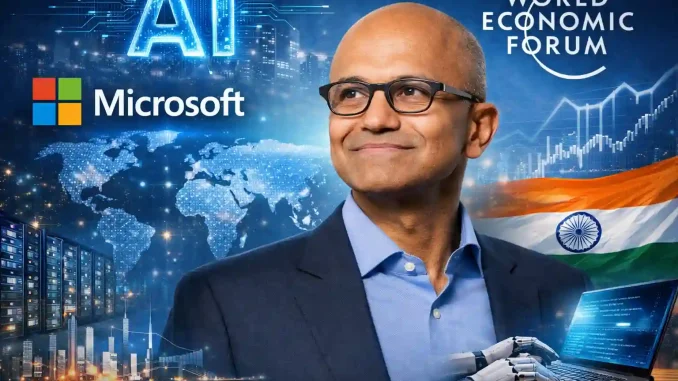
A CEO Shaping the Conversation Beyond Silicon Valley
Microsoft Chairman and Chief Executive Officer Satya Nadella is no longer speaking only to shareholders or developers. As artificial intelligence becomes central to global economic and political debates, Nadella has emerged as one of the most influential voices shaping how governments, businesses and citizens think about the technology’s future.
From global platforms such as the World Economic Forum to national policy discussions in India and the United States, Nadella has consistently delivered a clear message: artificial intelligence must demonstrate real world value, broad accessibility and responsible use. Without that, he has warned, the AI boom risks becoming unsustainable.
This positioning marks a significant evolution in Microsoft’s leadership narrative. Once known primarily for software dominance, the company under Nadella is now positioning itself as a long term infrastructure provider for the AI driven global economy.
From Hype to Proof of Value
In recent public appearances, Nadella has cautioned against treating artificial intelligence as an abstract technological race. He has argued that the next phase of AI growth will be defined not by model size or investment figures, but by whether the technology improves productivity, public services and quality of life at scale.
According to Nadella, AI adoption must move beyond experimental deployments and start delivering measurable outcomes in sectors such as healthcare, education, public administration and small business productivity. He has stressed that public trust will depend on visible benefits, especially as concerns rise around data privacy, misinformation and job displacement.
His remarks come at a time when global governments are drafting AI regulations and demanding accountability from technology companies. Nadella’s emphasis on responsible deployment reflects Microsoft’s attempt to align innovation with regulatory and societal expectations.
Microsoft’s Financial Strength in the AI Era
Microsoft’s confidence is backed by strong financial performance. In its most recent fiscal year results, the company reported quarterly revenue exceeding $76 billion, marking double digit growth year on year. Operating income and net profit also posted significant increases, driven largely by demand for cloud and AI services.
The Azure cloud platform has become the backbone of Microsoft’s AI strategy. With annual revenue crossing the $75 billion mark, Azure continues to expand across enterprise customers, governments and startups. Nadella has repeatedly highlighted cloud infrastructure as the foundation on which artificial intelligence adoption will scale globally.
Microsoft’s enterprise relationships give it a unique advantage. Rather than selling AI as a standalone product, the company is embedding it into familiar tools such as Office, Teams, Windows and enterprise security systems. This approach has helped accelerate adoption while reducing friction for businesses transitioning to AI assisted workflows.
India as a Strategic Technology Hub
One of the most significant developments under Nadella’s leadership has been Microsoft’s expanding footprint in India. During recent engagements with Indian policymakers and industry leaders, the company announced plans to invest $17.5 billion in India over the next four years, its largest single investment in the country to date.
The investment focuses on expanding cloud data center capacity, strengthening AI infrastructure and supporting digital public platforms. Microsoft is scaling its data center regions across multiple Indian cities to ensure low latency, secure and compliant cloud services for both public and private sector users.
India’s fast growing digital economy, combined with government backed digital public infrastructure, has made the country a central pillar of Microsoft’s global strategy. Nadella has openly praised India’s digital governance frameworks, calling them models for inclusive technology adoption.
Supporting Government Platforms and Public Services
Microsoft’s engagement in India goes beyond commercial expansion. The company has partnered with various government platforms to integrate AI driven solutions into public services. This includes tools for employment matching, skills analysis and labor market insights on national portals.
By deploying AI in public systems, Microsoft aims to demonstrate how large scale digital platforms can become more efficient and citizen centric. Nadella has argued that such use cases are essential to proving that artificial intelligence can deliver social value alongside economic growth.
These collaborations also reflect a broader trend where governments are seeking trusted technology partners rather than purely commercial vendors. Microsoft’s emphasis on compliance, data security and sovereign cloud capabilities has strengthened its standing in this space.
Focus on Skills and Workforce Readiness
A recurring theme in Nadella’s leadership is the importance of human capital in the AI transition. Microsoft has committed to training millions of people globally in AI related skills, with India as a major focus area.
Through national skilling initiatives and partnerships with educational institutions, the company has already trained millions of individuals in digital and AI capabilities. The goal is to prepare students, professionals and entrepreneurs for a labor market increasingly shaped by automation and intelligent systems.
Nadella has repeatedly stated that the AI era will reward adaptability rather than replace human talent outright. He has emphasized that technology companies must take responsibility for helping societies reskill at scale.
Leadership Recognition and Compensation
Microsoft’s corporate disclosures reflect confidence in Nadella’s leadership. For the most recent financial year, his total compensation rose to approximately $96.5 million, the highest since he became CEO in 2014. A significant portion of this compensation is stock based, tying long term incentives to company performance.
The board cited Microsoft’s strong execution during a period of major technological transition as a key factor behind the increase. Under Nadella, the company’s market value has grown multiple times, driven by its shift toward cloud services, enterprise platforms and now artificial intelligence.
A Broader Vision for Global Technology Growth
What sets Nadella apart from many of his peers is his consistent framing of AI as a shared global responsibility. He has warned against concentration of benefits among a small group of companies or countries, arguing that such imbalance could slow adoption and trigger regulatory backlash.
Instead, Nadella advocates for widespread access to AI infrastructure, open collaboration and responsible governance. This philosophy aligns with Microsoft’s positioning as an enabler rather than a gatekeeper of technology.
As debates around AI regulation, ethics and economic impact intensify, Nadella’s approach places Microsoft at the intersection of innovation and policy. His message is clear: the future of artificial intelligence will be decided not by ambition alone, but by trust, usefulness and inclusivity.
Looking Ahead
Microsoft’s trajectory under Satya Nadella suggests that the company sees artificial intelligence not as a short term opportunity, but as a multi decade transformation. Investments in infrastructure, partnerships with governments and focus on skills development indicate a long term strategy aimed at embedding AI into everyday systems.
For Nadella, the challenge now is execution at scale. As expectations rise and scrutiny intensifies, Microsoft’s ability to deliver tangible outcomes will define both its credibility and leadership in the AI era.
Leave a Reply